


Your university tuition is paid. Your accommodation deposit is secured. Then you arrive and discover that living costs exceed your projections by 30%. Groceries, transport, phone bills, and social activities drain your budget faster than anticipated. For most international students, part-time work is a survival.
But every country guards its student work rules differently. The United Kingdom allows 20 hours per week but bans self-employment entirely. Canada permits 24 hours off-campus but ties compliance to your Post-Graduation Work Permit eligibility. Australia measures work in fortnights, not weeks, a distinction that has triggered visa cancellations. Germany counts days annually, not hours weekly. And the United States restricts most students to campus jobs only.
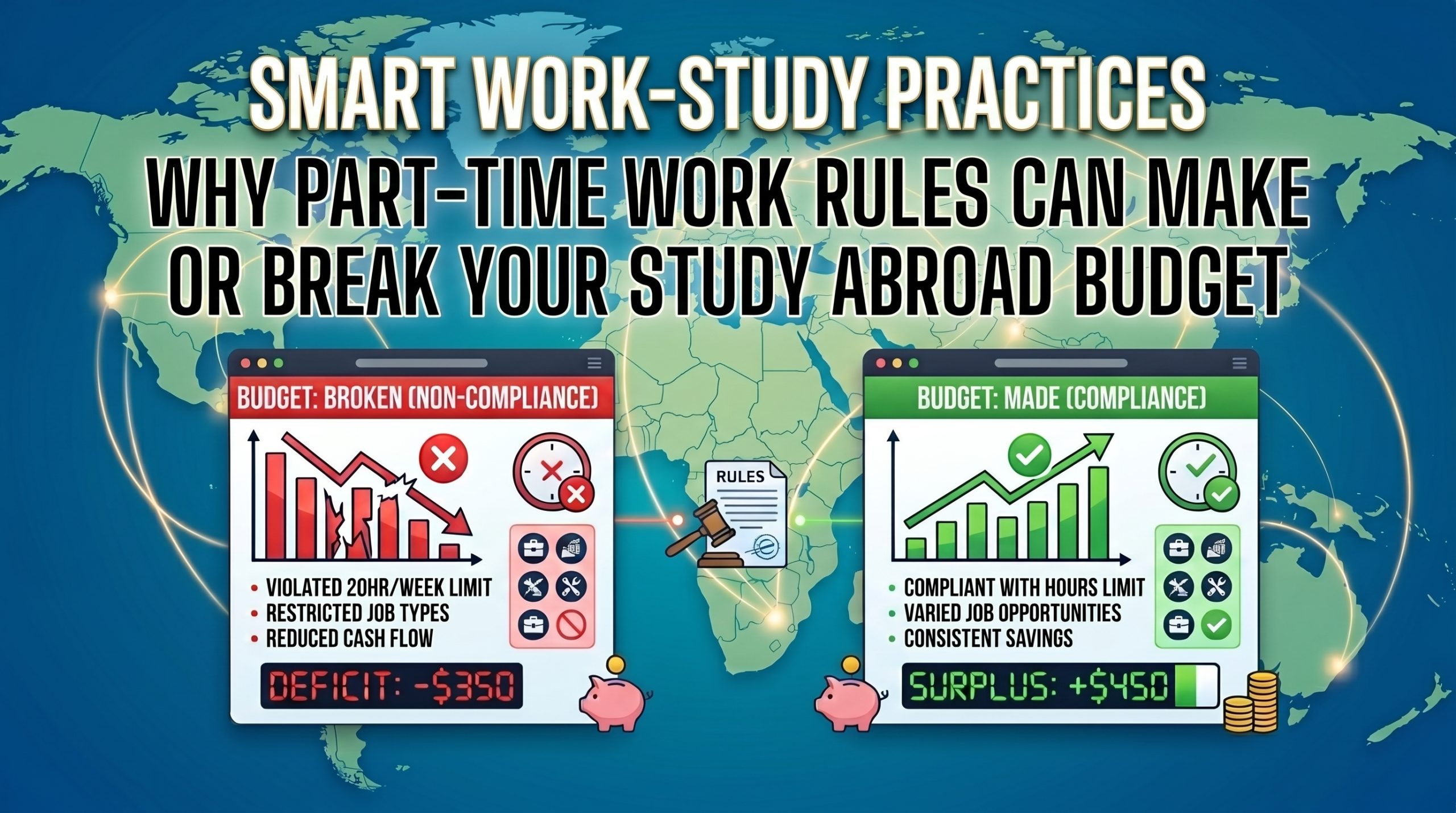
Violating these part-time work rules for international students carries consequences ranging from visa curtailment to deportation. Yet the rules are not arbitrary obstacles. They are manageable frameworks that, when understood precisely, allow you to earn meaningful income without jeopardizing your immigration status.
This guide provides technical clarity on work hour limits, minimum wage rates, tax obligations, and enforcement mechanisms across the major study destinations. You will learn exactly how many hours you can work, what you can expect to earn, and what happens if you accidentally exceed your limit.
The Universal Framework: How Countries Structure Student Work Rights
Despite national variations, most countries organize student work rights around three common pillars:
Term-Time vs. Break-Time Distinctions: All major destinations restrict hours during academic sessions while permitting full-time work during official university vacations . The critical variable is how each country defines “term time.” In the UK, it follows your specific course calendar. In Australia, it means any period when your course is “in session” as confirmed by your Confirmation of Enrolment. In Canada, it aligns with your institution’s academic schedule as registered with Immigration, Refugees and Citizenship Canada (IRCC).
On-Campus vs. Off-Campus Permissions: The United States severely restricts off-campus work for F-1 visa holders, requiring Curricular Practical Training (CPT) authorization . The UK, Canada, Australia, and Germany permit off-campus employment within hour limits. This distinction determines whether you can seek jobs in the broader economy or remain dependent on university payroll.
Cumulative vs. Per-Employer Counting: The UK and Canada count all work hours across all employers combined. Australia’s 48-hour fortnightly limit applies to your total employment, not per job. Working two 15-hour-per-week jobs still violates a 20-hour limit if the total exceeds it.
Tax and Documentation Requirements: Most countries require tax identification numbers before lawful employment begins. The UK uses your National Insurance Number. Canada requires a Social Insurance Number (SIN). Australia demands a Tax File Number (TFN). Germany requires registration with local authorities. Working without these numbers is possible but illegal, and employers who bypass them often exploit workers.
United Kingdom: 20 Hours and the Self-Employment Trap
The UK Student Route visa provides straightforward work rights with hidden restrictions that trap unwary students.
Hour Limits: During term time, you may work a maximum of 20 hours per week. This applies to all paid and unpaid work combined, across all employers . During official university vacations, Christmas, Easter, and summer breaks, you may work unlimited hours.
The “Week” Definition: UK Visas and Immigration defines a week as seven consecutive days starting on a Monday. Your 20-hour limit applies to this rolling period, not to a fixed Monday-to-Sunday calendar week. Working 25 hours one week and 15 the next still violates your visa conditions if any seven-day Monday-starting period exceeds 20 hours.
Prohibited Work Categories: The UK explicitly bans Student visa holders from:
- Self-employment or business activity
- Professional sportsperson or entertainer roles
- Full-time permanent positions
- Work as a doctor or dentist in training (unless on a recognized foundation program)
This self-employment prohibition is absolute. You cannot freelance, run an online store, or operate as an independent contractor. Even gig economy platforms like Deliveroo or Uber classify workers as self-employed under UK law, making them off-limits to Student visa holders.
Minimum Wage and Earnings: The National Living Wage stands at £11.44 per hour for workers aged 21 and over, and £8.60 for those aged 18 to 20 . Working 20 hours weekly during 30 weeks of term time plus full-time during 15 weeks of breaks yields realistic annual earnings of £7,000–£10,000 . This covers a significant portion of living costs outside London but will not fully fund tuition or London rents.
Tax Obligations: Students pay standard UK income tax if earnings exceed the personal allowance threshold (£12,570 annually as of 2025). Most part-time student workers fall below this threshold and owe no income tax, though National Insurance contributions may apply at lower earnings levels.
Canada: The 24-Hour Off-Campus Advantage
Canada revised its student work policy in November 2024, increasing the off-campus limit from 20 to 24 hours per week during academic sessions . This change makes Canada one of the most generous destinations for student employment.
Hour Limits: Eligible students with valid study permits may work up to 24 hours per week off-campus during regular academic periods. During scheduled breaks—winter holidays, reading week, summer vacation, full-time work is permitted .
Eligibility Requirements: Not all study permit holders qualify for off-campus work. You must:
- Hold a valid study permit with explicit work authorization
- Be enrolled full-time at a Designated Learning Institution (DLI)
- Be in an academic, vocational, or professional training program of at least six months duration
- Have started your program (pre-arrival work is generally prohibited)
The PGWP Connection: This is the critical detail most students miss. Working beyond your permitted 24 hours constitutes a violation of your study permit conditions. Such violations can render you ineligible for the Post-Graduation Work Permit (PGWP)—the three-year open work permit that serves as Canada’s primary pathway to permanent residency . A few extra hours at a restaurant job can cost you three years of full Canadian work rights.
Minimum Wage and Earnings: The federal minimum wage is CAD 17.30 per hour as of 2025, but provinces set their own rates . Ontario pays CAD 17.20, British Columbia CAD 17.40, and Alberta CAD 15.00 . At 24 hours per week across 40 academic weeks plus full-time summer work, a student could realistically earn CAD 21,000–24,000 annually . In lower-cost cities like Halifax or Winnipeg, this covers substantial living expenses.
Tax and SIN Requirements: You must obtain a Social Insurance Number (SIN) before starting work. Income tax applies federally and provincially, but students can file annual returns to claim refunds on overpaid taxes.
Australia: The Fortnight Calculation That Confuses Everyone
Australia’s work limit is technically generous but structurally complex. The 48-hour fortnight rule has triggered countless visa violations among students who misunderstand it.
Hour Limits: Student visa (Subclass 500) holders may work a maximum of 48 hours per fortnight while their course is in session . A fortnight is any 14-day period, not a fixed two-week calendar block. This means your hours are assessed on a rolling basis, every consecutive 14-day window must not exceed 48 hours.
The Rolling Calculation Trap: If you work 30 hours in week one and 20 hours in week two, you comply with a 48-hour fortnight. But if you work 35 hours in week one and 20 hours in week two, and your employer schedules you across a different 14-day window that captures 25 hours from week one and 30 hours from week two, you violate your visa. Track your hours daily, not weekly.
Break-Time Unlimited Work: During official course breaks, semester holidays and approved vacations, you may work unlimited hours . Research students (Master’s by research or PhD) face no capped working hours once their course has commenced.
Minimum Wage and Earnings: Australia’s national minimum wage is AUD 24.95 per hour as of July 2025 . Student roles typically pay AUD 20–30 per hour, with high-skill positions like academic tutoring reaching AUD 35 . This makes Australia the highest-paying student work destination globally. A student working 48 hours per fortnight at minimum wage earns approximately AUD 1,200 every two weeks—enough to cover living costs in most Australian cities except Sydney and Melbourne central districts.
Workplace Protections: International students receive the same protections as Australian employees under the Fair Work Act. This includes minimum wage enforcement, correct pay slips, tax withholding, and superannuation contributions even for casual roles . The Fair Work Ombudsman handles wage theft complaints, and student legal clinics provide free advice.
Tax and TFN Requirements: You need a Tax File Number (TFN) to work lawfully. Australia taxes residents on worldwide income, but most students qualify as residents for tax purposes if they live in Australia for more than six months. File annual tax returns to claim refunds on overpaid tax.
Germany: The 140-Day Annual Limit (2026 Update)
Germany operates on a fundamentally different system than Anglo-Saxon countries. Instead of weekly hour limits, Germany counts full working days annually.
The 2026 Policy Change: In March 2026, Germany increased the annual work allowance for international students from 120 full days to 140 full days (or 280 half-days) . This 16% expansion provides approximately 20 additional working days annually, equivalent to roughly €2,000 in extra after-tax income, enough to cover two months of rent in many German cities.
Day-Based Calculation: A “full day” in German employment law means up to 8 hours. A “half-day” means up to 4 hours. You may mix these flexibly throughout the year, but the total cannot exceed 140 full-day equivalents . This roughly translates to 20 hours per week during term time if distributed evenly, but you could also work intensively during semester breaks and less during exam periods.
Minimum Wage and Earnings: The minimum wage is €13.90 per hour . At 20 hours per week across 40 weeks, a student earns approximately €11,120 annually before tax. With the additional 20 days from the 2026 expansion, this increases by roughly €2,000 . Germany’s relatively low living costs (€992–€1,200 monthly outside major cities) make this income genuinely impactful.
Work Permit Integration: Student work rights are embedded in your residence permit under Section 16b of the Residence Act. No separate work permit is required for the 140-day allowance. However, exceeding this limit requires special permission from the Federal Employment Agency and local immigration office.
Tax and Social Insurance: Students working within the 140-day limit generally avoid mandatory social insurance contributions, keeping more of their earnings. Income tax applies only above the annual basic tax-free allowance (€11,604 as of 2025). Most student workers fall below this threshold.
United States: On-Campus Only with CPT/OPT Escape Hatches
The United States maintains the most restrictive student work framework among major destinations. Understanding its narrow pathways is essential for financial planning.
On-Campus Limits: F-1 visa holders may work up to 20 hours per week on-campus during term time . During official breaks, full-time on-campus work is permitted . “On-campus” means employment by the university, its contractors, or commercial firms physically located on campus providing direct student services .
Off-Campus Prohibition: Off-campus employment is generally prohibited unless authorized through specific programs:
- Curricular Practical Training (CPT): Work integral to your curriculum, authorized by your Designated School Official (DSO). Must be completed before graduation .
- Optional Practical Training (OPT): Post-completion work authorization for up to 12 months (36 months for STEM degrees). Requires USCIS approval .
- Severe Economic Hardship: Rarely granted; requires documented unforeseen circumstances beyond your control.
The CPT Timing Rule: CPT authorization can only be issued within an official academic term. The start date cannot precede the final exam period of the preceding term . For example, a Summer 2026 CPT authorization cannot start before May 21, 2026, if that is the Spring 2026 grading deadline.
Minimum Wage and Earnings: The federal minimum wage is $7.25 per hour, but states set higher rates, California reaches $17.00, Washington $16.66 . On-campus roles typically pay $10–$15 hourly. Annual earnings rarely exceed $8,000–$12,000, insufficient to cover living costs in major cities. This is why US students typically rely more heavily on family support and loans than on employment income.
Tax and Documentation: On-campus work does not require additional USCIS authorization but requires a Social Security Number (SSN). Federal and state income taxes apply, though most students qualify for refunds via annual tax returns.
Critical Warning: Unauthorized off-campus work constitutes a serious status violation. Consequences include termination of your SEVIS record, loss of all employment authorization, and potential 3- or 10-year bars on re-entry . Never accept off-campus employment without explicit DSO authorization.
Ireland and New Zealand: Smaller Markets, Specific Rules
Ireland: Stamp 2 visa holders may work 20 hours per week during term time and 40 hours per week during official holiday periods (June through September and December 15 through January 15) . A PPS number is required for lawful employment. The minimum wage is €12–€13 per hour . Only students on courses approved by the Interim List of Eligible Programmes (ILEP) qualify for work rights.
New Zealand: Effective November 3, 2025, eligible student visa holders may work up to 25 hours per week during term time, an increase from the previous 20-hour limit . Full-time work is permitted during Christmas and New Year holidays. Students with existing visas showing 20-hour limits must apply for a variation of conditions or a new visa to access the increased hours.
Comparative Earnings Table and Realistic Budget Impact
| Country | Term-Time Limit | Break-Time Limit | Min Wage (Local) | Min Wage (USD) | Annual Earnings (Realistic) | Living Cost Coverage |
|---|---|---|---|---|---|---|
| UK | 20 hrs/week | Unlimited | £11.44/hr | ~$14.50 | £7,000–10,000 | 50–70% outside London |
| Canada | 24 hrs/week | Unlimited | CAD 17.30/hr | ~$12.80 | CAD 21,000–24,000 | 60–80% most cities |
| Australia | 48 hrs/fortnight | Unlimited | AUD 24.95/hr | ~$16.50 | AUD 25,000–35,000 | 70–90% most cities |
| Germany | ~20 hrs/week (140 days/yr) | Included in 140 days | €13.90/hr | ~$15.20 | €11,000–13,000 | 60–80% most cities |
| USA | 20 hrs/week on-campus only | 40 hrs/week on-campus | $7.25–$17/hr | $7.25–$17 | $8,000–12,000 | 30–50% most cities |
| Ireland | 20 hrs/week | 40 hrs/week (holidays) | €12–13/hr | ~$13.00 | €10,000–14,000 | 50–70% Dublin; higher elsewhere |
| New Zealand | 25 hrs/week | Unlimited (holidays) | NZD 23.15/hr | ~$14.00 | NZD 24,000–30,000 | 60–80% most cities |
Key Insight: Australia offers the highest earning potential due to its elevated minimum wage and generous hour limits. The USA offers the lowest relative earning capacity due to on-campus restrictions and lower federal minimum wages. Canada strikes the best balance between earning potential, living cost alignment, and post-study work permit security.
What Happens When You Break the Rules: Consequences and Remedies
United Kingdom: Exceeding 20 hours during term time constitutes a breach of visa conditions. UKCISA warns that this can lead to visa curtailment (shortening of your visa duration), refusal of future visa applications, and potential deportation. Employers who knowingly allow violations may also face penalties.
Canada: IRCC explicitly states that working beyond 24 hours off-campus violates study permit conditions. Consequences include loss of student status, requirement to leave Canada, and refusal of future study or work permits. The PGWP impact is the most severe long-term consequence.
Australia: The Department of Home Affairs may cancel your Student visa (Subclass 500) for work condition breaches. Real cases exist of students working 60-hour weeks as ride-share drivers, resulting in visa cancellation and future application bans.
Germany: Exceeding 140 days requires special authorization. Working beyond this without permission jeopardizes your residence permit under Section 16b and can complicate future visa applications, including the Blue Card pathway.
United States: Unauthorized work terminates your F-1 status, voids all employment authorization including OPT, and may trigger unlawful presence accrual leading to 3- or 10-year re-entry bars.
If You Accidentally Exceed Your Limit:
- Stop working immediately
- Document the violation as accidental and isolated
- Contact your university’s international student office before immigration authorities contact you
- Seek legal advice from a qualified immigration attorney
- Do not attempt to hide the violation, proactive disclosure often mitigates consequences